Science-backed conversion

Dog Age Calculator — ConvertDog Years to Human Years

Find out how old your dog really is. Our calculator uses three science-backed methods — including the latest DNA research — to convert your dog’s age into human years based on breed and size.

  • AKC & AVMA method
  • UCSD epigenetic clock
  • 95 breed lifespans
How should we identify your dog?

How old is your dog?
3 years

Used on the result card, the share image and the printable vet note.

In human years, your dog is…

28human years

Mature Adult

In the prime of life, settled personality, steady companion

3 years old · medium dog · AKC / AVMA size-adjusted

23% of expected lifespan~10 years of typical lifespan remaining

Compare all methods

AKC / AVMA size-adjustedThe veterinary standard: published AKC values, identical for every size through year 5, then size-dependent from year 628
UCSD epigenetic clock16 × ln(age) + 31 — from DNA methylation research, Cell Systems 202048.6
Classic 7× rule OutdatedA myth with no scientific basis — shown only for comparison21

Care tip

Monitor weight closely, begin annual baseline bloodwork, maintain regular exercise

Vet schedule

Annual exam with baseline diagnostics

Section 01 — The myth

The “Multiply by 7” Rule Is a Myth — Here Is What Science Says

The old rule

dog age × 7

One multiplier for every dog, at every age, of every size.

What research shows

15 → 24 → 36 → +4 to +8

Fast early aging, the same for every dog to age five, then a yearly rate set by the dog’s size.

For decades, dog owners relied on a simple formula: multiply your dog’s age by seven to get the human equivalent. A 5-year-old dog equals a 35-year-old person. Simple, memorable, and completely wrong.

The origin of this rule traces back to the 1950s. The math was crude — divide the average human lifespan (roughly 70 years) by the average dog lifespan (roughly 10 years) and you get 7. It was never based on biology. Veterinarian William Fortney of Kansas State University has called it little more than a marketing ploy designed to encourage pet owners to bring their dogs in for annual checkups.

Here is the problem: a one-year-old dog is already sexually mature, has a full set of adult teeth, and can reproduce. No seven-year-old child can do any of that. A two-year-old dog has reached full physical size and social maturity — closer to a 24-year-old human than a 14-year-old. Kelly M. Cassidy, a curator at the Charles R. Connor Museum at Washington State University who compiles longevity studies on dogs, put it bluntly:You can’t really kill the seven-year rule. (Both quotes via the American Kennel Club.)

Modern veterinary science tells a different story. Dogs age rapidly in their first two years of life, then the pace slows. Through age five every dog follows the same curve, and from age six how quickly they continue to age depends heavily on their size and breed. A 7-year-old Chihuahua and a 7-year-old Great Dane are not the same age in biological terms. Not even close.

That is why a proper dog age calculator accounts for non-linear aging, breed size, and the latest peer-reviewed research rather than relying on a single multiplier that was never meant to be taken literally. See the full dog years to human years chart for every size from age 1 to 20.

Section 02 — The methods

Three Ways to Convert Dog Years — and Why They Give Different Answers

There is no single universally accepted formula for converting dog years to human years. Instead, three methods dominate veterinary science and academic research. Each approaches the question from a different angle, and each has strengths and limitations. Our calculator shows all three so you can see the full picture.

1
Veterinary standard

Method 1 — The AKC / AVMA Size-Adjusted Table

This is the size-based chart published by the American Kennel Club, drawing on American Veterinary Medical Association guidance. It is the conversion most dog owners and many veterinary clinics in the United States use.

The logic works in three phases. The first year of a dog’s life equals approximately 15 human years — reflecting the explosive growth from helpless newborn to sexually mature adolescent. The second year adds another 9 human years, bringing the total to 24. Years three to five then add 4 human years each for every dog, regardless of size, reaching 36 at age five.

From age six, size takes over. Averaged across ages 6 to 16 on the chart, small dogs under 20 pounds add about 4 human years per calendar year, medium dogs (20 to 50 pounds) about 4.6, large dogs (50 to 100 pounds) about 5.7, and giant breeds over 100 pounds about 7.7 — including a jump of 13 human years between ages five and six.

+4Small
+4.6Medium
+5.7Large
+7.7Giant
StrengthThis method’s strength is its simplicity and the fact that it accounts for the single most important variable in canine aging: body size.
WeaknessIts weakness is that it groups all breeds into just four buckets, meaning a healthy Border Collie and an overweight Bulldog in the same weight range get identical results despite very different biological profiles.
2
DNA-based formula

Method 2 — The UCSD Epigenetic Clock

In 2020, a research team at the University of California San Diego led by Tina Wang and Trey Ideker published a groundbreaking study in the peer-reviewed journal Cell Systems (Wang et al., 2020). The paper was titled “Quantitative Translation of Dog-to-Human Aging by Conserved Remodeling of the DNA Methylome,” and it introduced a fundamentally different approach to the dog age question.

Instead of relying on estimated lifespans or veterinary consensus, the researchers looked at DNA methylation — a chemical modification of DNA where methyl groups attach to specific sites along the genome in predictable, age-dependent patterns. These patterns form what scientists call an “epigenetic clock,” a biological marker that tracks how much an organism has actually aged at the cellular level.

The team collected blood samples from 104 dogs, primarily Labrador Retrievers, aged from about five weeks (0.1 years) to 16 years. They then compared the dogs’ methylation profiles against data from 320 humans aged 1 to 103. According to UC San Diego, the work was funded in part by the National Institutes of Health.

The resulting formulahuman_age = 16 × ln(dog_age) + 31

The result was a logarithmic formula:human age equals 16 multiplied by the natural logarithm of the dog’s age, plus 31.This formula captures a key biological reality — dogs age extraordinarily fast in their first year of life and then slow down considerably. Under this model, a one-year-old dog is biologically comparable to a 31-year-old human, and a four-year-old dog is closer to 53.

The main limitation is that the study was conducted primarily on Labrador Retrievers. Different breeds with different body sizes, lifespans, and genetic backgrounds will not follow the exact same curve. The researchers acknowledged this, and subsequent work has begun extending epigenetic clock models to other breeds and species. The formula also only holds within the ages studied — see why itbreaks down when you convert human years to dog years.

3
Outdated

Method 3 — The Classic 7× Rule

Our calculator includes the old multiply-by-seven result for one reason: to show you exactly how far off it is. At every age beyond two years, the 7× rule either overestimates or underestimates your dog’s true biological age. It ignores size, breed, and the well-documented non-linear aging pattern that all modern research confirms. We display it with a clear “outdated” label so you can see the contrast for yourself.

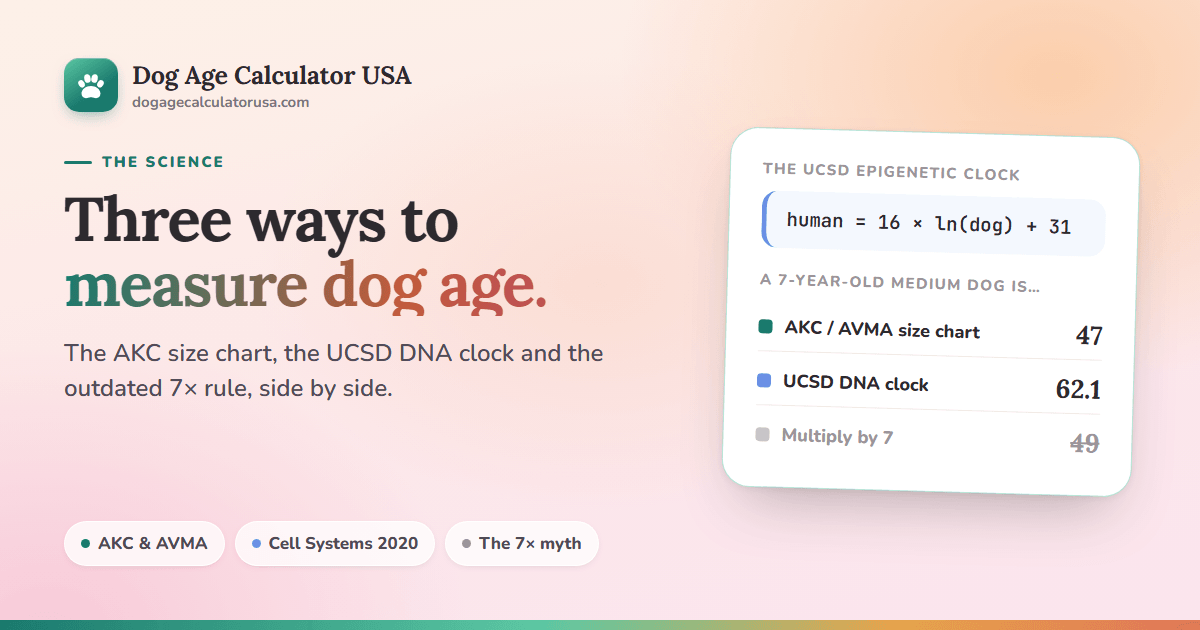
Infographic comparing three dog age methods for a 7-year-old medium dog: the AKC/AVMA size chart gives 47 human years, the UCSD DNA clock (human age = 16 × ln(dog age) + 31) gives 62.1, and the outdated multiply-by-7 rule gives 49.
The same 7-year-old medium-sized dog, three answers: 47 on the AKC/AVMA chart, 62.1 by the UCSD epigenetic clock, and 49 by the outdated 7× rule.

Section 03 — The chart

Dog Years to Human Years Chart — All Sizes Compared

The table below shows the full conversion from dog years to human years for all four size categories, based on the AKC and AVMA guidelines used by veterinarians. Use it as a quick reference alongside our calculator.

Small — under 20 lbs Medium — 20–50 lbs Large — 50–100 lbs Giant — over 100 lbs
Dog years to human years conversion for small, medium, large and giant dogs from 1 to 16 years of age.
Dog AgeSmall (Under 20 lbs)Medium (20–50 lbs)Large (50–100 lbs)Giant (Over 100 lbs)
1 year15151515
2 years24242424
3 years28282828
4 years32323232
5 years36363636
6 years40424549
7 years44475056
8 years48515564
9 years52566171
10 years56606679
11 years60657286
12 years64697793
13 years687482100
14 years727888107
15 years768393114
16 years808799121

Notice how the numbers are identical across all sizes for the first five years, then begin to diverge sharply. By age 10, a small dog is roughly 56 in human years while a giant breed has already reached 79 — a gap of 23 human years from the same calendar age. By 13, a giant breed dog reaches 100 in human-equivalent age while a small dog of the same age sits at 68.

This divergence is not a quirk of the formula. It reflects a well-documented biological reality: large and giant breed dogs age significantly faster than their smaller counterparts after reaching physical maturity. Values follow the published AKC dog years chart. For an interactive version you can filter by size, open the full dog age chart, orcompare two or three dogs side by side.

See where your own dog lands on every one of these three methods.

Run the calculator →

Section 04 — The size paradox

Why Small Dogs Live Longer Than Large Dogs — The Size-Lifespan Paradox

Across the animal kingdom, bigger generally means longer-lived. Elephants outlive mice. Whales outlive rabbits. But domestic dogs break this rule entirely. Within the same species, the smallest breeds routinely live twice as long as the largest ones, and scientists have spent decades trying to understand why.

The Numbers Are Stark

A Toy Poodle or Chihuahua can expect to live 14 to 16 years. A Great Dane averages just 7 to 10. The Dogue de Bordeaux, according to American Kennel Club breed data, has one of the shortest average lifespans of any recognized breed at just 5 to 8 years. On the opposite end, the AKC lists the Coton de Tuléar at 15 to 19 years.

The largest dataset on the question tells the same story. An analysis of more than 13 million dogs seen at Banfield Pet Hospitals across the United States (Montoya et al., 2023) put life expectancy at birth at 13.5 years for small purebred dogs, 11.5 for large breeds and just 9.5 for giant breeds.

14.95Small dogsaverage years lived
13.86Medium dogsaverage years lived
13.38Large dogsaverage years lived

A major study by Dr. Silvan Urfer, which analyzed data from 169,000 dogs that died or were euthanized at veterinary clinics in the United States, found that small dogs lived 14.95 years on average, medium dogs 13.86 years, and large dogs 13.38 years (AKC, citing Urfer). Body size was the single most important variable in predicting how long a dog would live — more important than whether the dog was purebred or mixed breed.

The Science Behind It

The most comprehensive explanation came from a 2013 study published in The American Naturalist (Kraus et al., 2013) by evolutionary biologist Cornelia Kraus at the University of Göttingen, along with Samuel Pavard and Daniel Promislow. Their team analyzed mortality data from 74 dog breeds and more than 56,000 individual dogs from the Veterinary Medical DataBase.

Their conclusion was striking. Large dogs do not die younger because they get sick earlier or because they have higher rates of death as puppies. They die younger because they age faster. Once a large dog reaches maturity, its biological clock ticks at a measurably faster rate than a small dog’s. For every 2 kilograms of additional body mass across breeds, life expectancy drops by approximately one month.

The leading hypothesis points to growth rate. Large and giant breeds grow from tiny puppies to enormous adults in a remarkably short time. A Great Dane puppy can gain over 45 kilograms in its first year alone. This rapid growth appears to accelerate cellular damage, increase oxidative stress, and raise the risk of abnormal cell division — which may explain why cancer is the leading cause of death in many large breeds.

The Epigenetic Evidence

The Dog Aging Project, a landmark longitudinal study funded by the National Institute on Aging and co-founded by Daniel Promislow at the University of Washington, has been tracking companion dogs across the United States since 2018. With more than 50,000 dogs enrolled as of 2025 (Dog Aging Project), it is the largest study of its kind ever conducted.

In 2024, Dog Aging Project researchers reported in a preprint, not yet peer-reviewed (McCoy et al.), that dogs from the largest breed sizes have epigenomes that are on average 0.37 years older per chronological year than dogs from the smallest breed sizes. In other words, the DNA of a large dog appears to show more biological wear and tear at the same calendar age than that of a small dog — evidence that the aging gap is written into the chemistry of their cells, not only into lifespan statistics. See how the gap plays out year by year in the dog age chart by size.
Section 05 — The life stages

The Five Life Stages of a Dog — From Puppy to Senior

A dog’s age in human years is most useful when it helps you understand what your dog needs right now. That is where life stages come in. The American Animal Hospital Association published its updated Canine Life Stage Guidelines in 2019, dividing a dog’s life into five distinct phases. Each stage comes with different nutritional requirements, different veterinary screening needs, and different behavioral expectations.

Stage 01

Puppy (Birth to 6–9 Months)

The fastest and most transformative period of a dog’s life. In human terms, a puppy goes from newborn to roughly the equivalent of a young teenager within months. Puppies undergo rapid skeletal growth, develop their permanent teeth, and begin social learning that shapes their behavior for life. This stage ends when the period of rapid growth tapers off — typically around 6 months for small breeds and closer to 9 months for larger ones.

During this stage, veterinary visits are frequent. The core vaccine series typically begins at 6 to 8 weeks of age and repeats every few weeks until about 16 weeks. Nutrition should consist of a complete and balanced puppy formula carrying AAFCO label confirmation, fed in small, frequent meals.

Stage 02

Young Adult (6–9 Months to 3–4 Years)

Physical growth is slowing or complete, but social and behavioral maturity is still developing. In human age terms, this roughly corresponds to the late teens through mid-twenties. Young adult dogs have reached their full size (or close to it in giant breeds), have all their adult teeth, and are reproductively mature. Their energy levels are typically at their peak.

The AAHA recommends a wellness exam at least once a year during this stage. This is also the time to discuss spaying or neutering, dental care routines, and long-term nutrition plans.

Stage 03

Mature Adult (3–4 Years to the Start of the Last 25% of Expected Lifespan)

This is the longest and most stable stage for most dogs. In human terms, it spans from the late twenties through middle age. Dogs in this stage have settled into their personalities, their bodies are fully developed, and routine health maintenance is the primary veterinary focus.

The key transition in this stage is the introduction of baseline diagnostics. Annual bloodwork, urinalysis, and parasite screening become standard recommendations. Weight management becomes increasingly important, as excess weight during this period has measurable effects on lifespan — more on that later.

Stage 04

Senior (Last 25% of Expected Lifespan)

When a dog enters its senior years depends almost entirely on its size. According to the AAHA guidelines, the senior stage begins during the last quarter of a dog’s estimated lifespan. For small breeds, that may not arrive until age 10 to 12. For giant breeds like Great Danes or Saint Bernards, it can begin as early as age 5 to 6. Large breeds typically cross the threshold at 7 to 8 years, and medium breeds at 8 to 10.

In human age terms, a senior dog is generally somewhere between 55 and 80+ depending on size and breed. The AAHA guidelines suggest considering exams every six months for seniors, with expanded screening for kidney function, liver health, thyroid levels, and early signs of cognitive decline.

Stage 05

End of Life

The final stage is not defined by a specific age but by a shift in clinical focus from treatment to comfort and quality of life. Dogs in this stage may experience significant cognitive decline, chronic pain, organ failure, or terminal illness. Veterinary care centers on palliative support, pain management, and helping owners make compassionate decisions.

As the AAHA 2023 Senior Care Guidelines put it: “Old age is not a disease.” Senior and end-of-life dogs can still experience comfort, connection, and quality of life with the right care.

Section 06 — By breed

Dog Age by Breed — Why a 10-Year-Old Lab Is Not the Same as a 10-Year-Old Dachshund

When you enter your dog’s breed into our calculator, the result is calibrated to that breed’s expected lifespan and size profile. Here is a look at how aging plays out across some of the most popular dog breeds, using both the AKC size-adjusted method and available breed-specific longevity data.

Small Breeds — The Longest Lives

Small dogs under 20 pounds are the marathon runners of the canine world. Their first year still equals about 15 human years and their second year still reaches 24, but after that, each year adds only about 4 human years. A 10-year-old Chihuahua is roughly 56 in human terms — solidly middle-aged. Small-breed owners cancalculate a small dog’s age directly.

Chihuahua: Average lifespan of 14 to 16 years, among the longest of any breed. At 10 years old, a Chihuahua is approximately 56 in human years and typically still has several active years ahead. Senior status begins around 11 to 13 years.

Dachshund: Lives 12 to 16 years on average. Known for longevity despite their vulnerability to intervertebral disc disease. A 10-year-old Dachshund is around 56 in human years.

Yorkshire Terrier: The AKC lists a life expectancy of 11 to 15 years. Weight matters for this breed: in a study of neutered pet dogs (Salt et al., 2019), normal-weight male Yorkies had a median lifespan of 16.2 years against 13.7 for overweight males — a 2.5-year gap linked to body condition.

Medium Breeds — The Middle Ground

Dogs between 20 and 50 pounds follow the shared curve to 36 at age five, then add about 4 to 5 human years per calendar year. They occupy the statistical center of the dog lifespan spectrum, with most breeds living 10 to 14 years.

Beagle: The AKC lists a life expectancy of 10 to 15 years. A 10-year-old Beagle is about 60 in human years — approaching senior status but often still energetic and food-motivated.

Pembroke Welsh Corgi: Lives 12 to 13 years, according to the AKC. Despite being low to the ground, Corgis are classified as medium-sized by weight and age at a moderate rate. Senior status begins around 9 to 11 years.

French Bulldog: Average lifespan of 10 to 12 years, and America’s most popular breed every year since 2022 (AKC breed rankings). A 2024 study in Scientific Reports (McMillan et al., 2024), analyzing 584,734 UK dogs, found that brachycephalic (flat-faced) breeds including French Bulldogs have significantly shorter lifespans than non-brachycephalic breeds of similar size. Breathing difficulty, heat intolerance, and spinal problems contribute to earlier health decline.

Large Breeds — The Faster Clock

Dogs between 50 and 100 pounds jump from 36 to 45 between ages five and six, then add roughly 5 to 6 human years annually. Many of the most popular breeds in the United States and worldwide fall into this category.

Labrador Retriever: America’s most popular breed for 31 consecutive years before the French Bulldog took the top spot in 2022. The AKC lists a life expectancy of 11 to 13 years. The UCSD epigenetic study was conducted primarily on Labs, making them the most precisely mapped breed for biological aging. A 10-year-old Lab is approximately 66 in human years and is firmly in the senior category. Golden Retrievers age at a nearly identical rate, with a typical lifespan of 10 to 12 years. Cancer weighs heavily on the breed: in the Golden Retriever Club of America’s 1998 health survey, about 61% of reported deaths were caused by cancer.

German Shepherd: Lives 12 to 14 years, according to the AKC. A working breed that tends to remain physically active longer than other large breeds but is prone to hip dysplasia and degenerative myelopathy. A 10-year-old German Shepherd is approximately 66 in human years.

Boxer: Average lifespan of 10 to 12 years. Boxers have one of the highest cancer rates among all breeds, which contributes to a lower-end lifespan within the large-dog range. Senior status begins around 7 to 9 years.

Giant Breeds — The Fastest Aging

Dogs over 100 pounds age at the fastest rate of any size category. After matching every other dog to age five, they jump 13 human years at age six and add about 7 to 8 human years per calendar year after that. The gap between a giant breed and a small breed widens dramatically with each passing year.

Great Dane: Average lifespan of just 7 to 10 years. A 5-year-old Great Dane is already 36 in human years, and by age 7, they are 56 — the equivalent of a middle-aged to senior human. The breed enters senior status as early as age 5 to 6, younger than most small breeds reach their prime.

Bernese Mountain Dog: One of the shortest-lived popular breeds, with an AKC life expectancy of 7 to 10 years. Berners are predisposed to histiocytic sarcoma, an aggressive cancer. A 5-year-old Bernese is already entering its senior phase.

Saint Bernard: Lives 8 to 10 years. Despite their gentle temperament and popularity, Saint Bernards cross into senior territory before many medium-sized dogs reach middle age.

Among giant breeds, the Great Pyrenees stands out as a notable exception, living around 11 years on average — comparable to many large-breed dogs rather than typical giants. To see how two breeds diverge year by year, compare their ages side by side, or browse lifespans and senior ages for all 91 breeds.

Section 07 — The signs

How to Tell If Your Dog Is Getting Older — 8 Signs to Watch For

Understanding your dog’s age in human years is only part of the picture. The other part is recognizing the physical and behavioral changes that signal aging is underway. Some of these changes are normal. Others may indicate conditions that respond well to early veterinary intervention.

01

Gray hair around the muzzle and face

This is usually the first visible sign of aging, often appearing between 5 and 7 years in larger breeds and somewhat later in smaller ones. Some dogs gray earlier due to genetics or stress, but progressive graying that spreads from the muzzle is a reliable indicator of advancing age.

02

Cloudy or bluish eyes

A condition called lenticular sclerosis causes the lens of the eye to develop a grayish-blue haze. It is a normal part of aging and does not significantly impair vision. It should not be confused with cataracts, which appear white and opaque and can lead to blindness. A veterinarian can distinguish between the two during a routine exam.

03

Decreased energy and increased sleep

Older dogs naturally require more rest. A senior dog may sleep 14 to 16 hours per day compared to the 10 to 12 hours typical of a young adult. Sudden or dramatic drops in energy, however, can signal pain, heart disease, hypothyroidism, or other treatable conditions.

04

Stiffness and reduced mobility

Joint stiffness, reluctance to climb stairs, difficulty jumping into the car, and a slower pace on walks are hallmarks of aging. Osteoarthritis affects a large percentage of senior dogs, particularly in large and giant breeds. Early detection and management — through weight control, appropriate exercise, joint supplements, and veterinary guidance — can significantly improve comfort and mobility.

05

Dental changes

Worn, discolored, or missing teeth, along with gum disease and persistent bad breath, are increasingly common as dogs age. Periodontal disease is the most common health problem in adult dogs — a widely cited estimate puts it at more than 80 percent of dogs over the age of three — and it can contribute to heart, liver, and kidney problems if untreated.

06

Hearing loss

Age-related hearing decline is gradual and often goes unnoticed until it becomes significant. Owners may first observe that their dog no longer responds to verbal commands from a distance, sleeps through noises that previously triggered a reaction, or startles more easily when approached from behind.

07

Weight fluctuations

Senior dogs may gain weight due to decreased activity and a slowing metabolism, or lose weight due to muscle wasting, decreased appetite, or underlying disease. Maintaining a healthy body condition score through appropriate nutrition and portion control is one of the most impactful things an owner can do for a senior dog’s health and longevity.

08

Cognitive changes

Canine Cognitive Dysfunction, sometimes compared to Alzheimer’s disease in humans, affects a significant percentage of dogs over the age of 11. Symptoms include disorientation, altered sleep-wake cycles (pacing at night, sleeping during the day), decreased interaction with family members, indoor accidents in previously house-trained dogs, and aimless wandering or staring at walls. CCD is progressive but can be managed with veterinary support, dietary changes, environmental enrichment, and in some cases medication.

Section 08 — The research

What Researchers Are Learning About How Dogs Age — And What It Means for Humans

The science of canine aging is not a settled topic with a single answer. It is an active and rapidly evolving field of research, and several of the most significant studies in history are still underway.

The Dog Aging Project — 50,000 Dogs and Counting

50,000+companion dogs enrolled across the United States as of 2025

The Dog Aging Project is the largest and most ambitious longitudinal study of aging in companion dogs ever undertaken. Funded by the National Institute on Aging (part of the National Institutes of Health) and co-founded by Daniel Promislow at the University of Washington, the project began in 2018 and passed 50,000 enrolled dogs in 2025 (Dog Aging Project).

A smaller Precision Cohort of several hundred dogs provides DNA methylation, blood biomarker, and genome sequencing data that researchers are using to map the biological mechanisms of aging at an unprecedented scale.

One of the project’s most striking early findings, released as a 2024 preprint that has not yet completed peer review (McCoy et al., 2024 (preprint)), points at the molecular level to what lifespan data had long suggested: larger breeds show accelerated epigenetic aging. In an analysis of 864 dogs, the largest breed sizes had epigenomes that were on average 0.37 years older per chronological year than the smallest breeds. If confirmed, it means that at the level of DNA chemistry a five-year-old Great Dane has experienced more biological aging than a five-year-old Pomeranian — a sign that the size-lifespan relationship reflects differences in the rate at which cells age, not only disease prevalence.

The project continues to collect data on diet, environment, exercise, behavior, and health outcomes, with the goal of identifying interventions that could slow aging in dogs — and potentially inform human aging research as well. Because companion dogs share our homes, breathe the same air, and are exposed to many of the same environmental factors as their owners, they are a uniquely valuable model for studying how we all age.

The Epigenetic Clock — A Biological Measure of Age

2013the year the epigenetic clock was first formalized

The concept of an “epigenetic clock” — first formalized by Steve Horvath at UCLA in 2013 (Horvath, 2013) — has transformed how scientists think about aging. Rather than counting birthdays, epigenetic clocks measure the accumulation of chemical changes to DNA that occur predictably over time. These methylation patterns reflect biological aging: how much wear and tear a body has actually experienced, as opposed to how many years have passed since birth.

Earlier work had already built epigenetic clocks for dogs and wolves. The 2020 UC San Diego study by Wang and Ideker (Wang et al., 2020) went a step further: it was the first to translate dog methylation age directly into human years, showing that dogs and humans share conserved methylation changes in genes governing development and aging. That translation is the formula behind the epigenetic result in our calculator.

What makes epigenetic clocks especially valuable is that they can potentially measure the effectiveness of interventions. If a diet, drug, or lifestyle change truly slows biological aging, it would show up as a younger epigenetic age relative to calendar age. This is one of the key goals of the Dog Aging Project’s ongoing work.

The Banfield Life-Expectancy Study — 13 Million Dogs

12.69years of life expectancy at birth, across all US dogs studied

In 2023, researchers from Royal Canin and Banfield Pet Hospital published life-expectancy tables built from the medical records of more than 13 million dogs seen at Banfield hospitals across the United States between 2013 and 2019 (Montoya et al., 2023). They put the life expectancy of a newborn dog at 12.69 years.

The size gradient was unmistakable: small purebred dogs had a life expectancy at birth of 13.5 years, large breeds 11.5 and giant breeds just 9.5. Body condition mattered too — dogs whose median body condition was obese had a life expectancy of 11.7 years, about a year and a half less than dogs at an ideal weight. In the UK, the Royal Veterinary College’s VetCompass programme reached a similar picture from 30,563 dogs (Teng et al., 2022), estimating 11.2 years at birth.

Section 09 — Weight & longevity

How Weight Affects Your Dog’s Age — The Data Is Clear

If there is one factor within every dog owner’s control that has the biggest documented impact on lifespan, it is body weight. The relationship between weight management and longevity in dogs is supported by some of the strongest evidence in veterinary science.

A landmark study that followed pairs of Labrador Retriever littermates over their entire lives (Kealy et al., 2002) found that dogs kept at a lean body condition through a restricted diet lived a median of 1.8 years longer than their fully fed littermates — 13.0 years against 11.2. They also showed a delayed onset of chronic diseases, including osteoarthritis.

+1.8 yrsLean Labradors vs. their fully fed littermates
16.2 vs 13.7Normal-weight vs. overweight male Yorkshire Terriers (median years)

The pattern shows up in smaller breeds too. A study of neutered pet dogs (Salt et al., 2019) found that normal-weight male Yorkshire Terriers had a median lifespan of 16.2 years, while overweight males had a median of 13.7 years — a gap of 2.5 years. It was an observational study of 50,787 dogs, so it shows an association rather than proving cause, but overweight dogs had a shorter median lifespan in all 12 breeds it examined.

The biggest risk is obesity rather than a few extra pounds. In the 13-million-dog Banfield dataset (Montoya et al., 2023), dogs whose body condition was obese had a life expectancy at birth of 11.7 years, against 13.2 years for dogs at an ideal weight. Overweight dogs were close to ideal-weight dogs in that study, which is a reason to act before mild excess weight becomes obesity.

The practical takeaway: knowing your dog’s age in human years is valuable for understanding their life stage, but keeping them at a healthy weight is one of the most powerful things you can do to help them reach the upper end of their breed’s lifespan range rather than the lower end. A veterinarian can assess your dog’s body condition score and recommend appropriate calorie intake based on their age, size, activity level, and health status.

Section 10 — By the numbers

Dog Ownership in America — Why Dog Age Matters to Millions

The question “how old is my dog in human years” is being asked by more people than ever, because more American households live with dogs than at any point on record.

87.3Mpet dogs in the United States (AVMA)
53%of US households own a dog (APPA)
$158BUS pet industry spending in 2025 (APPA)
1.6dogs in the average dog-owning home (AVMA)

The United States

According to the AVMA’s 2025 Pet Ownership and Demographics Sourcebook, the United States is home to an estimated 87.3 million pet dogs — up from 52.9 million in 1996. The average dog-owning household keeps 1.6 dogs, a figure that has held steady since 1987.

The American Pet Products Association reported that US pet industry spending reached $158 billion in 2025, with $165 billion projected for 2026; food and treats alone accounted for $68.3 billion. Dog ownership rose from 51 to 53 percent of households during 2025, adding roughly 4 million new dog-owning homes in a single year, and about 95 million US households now own at least one pet of any kind.

Perhaps the most relevant statistic for a dog age calculator: senior animals make up about 44 percent of the pet dog and cat population, according to the AAHA 2023 Senior Care Guidelines. Tens of millions of American dogs are in the life stage where understanding their age in human terms has direct implications for diet, exercise, veterinary care, and quality of life.

The Global Picture

The relationship between humans and dogs is not uniquely American. Europe, Latin America, and parts of Asia have seen sustained growth in pet ownership, and the same questions about canine aging and longevity are being asked by dog owners on every continent.

In the United Kingdom, the Royal Veterinary College’s VetCompass programme has compiled one of the largest veterinary datasets in the world and produced the UK’s first life tables for companion dogs (Teng et al., 2022). In Germany, evolutionary biologist Cornelia Kraus, then at the University of Göttingen, led the landmark size-lifespan study that reshaped how the world understands canine aging. In Japan, pet dogs and cats together now outnumber children under 15, driving demand for geriatric veterinary care and senior-specific pet products.

The universality of the question “how old is my dog” reflects something deeper about the human-animal bond: when we assign a human age to our dogs, we are trying to understand their experience — their vitality, their needs, their remaining time — through a lens that makes sense to us. It is both a practical tool and an emotional one.

Section 11 — The record holders

The Oldest Dogs in History — And What We Can Learn From Them

Understanding how long dogs can live puts individual aging in context. While most dogs live 10 to 13 years, a handful of exceptional individuals have far exceeded those averages.

Verified record

Bluey — The Verified Record Holder

29 years, 5 months

Australian Cattle Dog · Victoria, Australia · 1910–1939

The longest-lived dog that Guinness World Records has verified is Bluey, an Australian Cattle Dog who lived to 29 years and 5 months. Born in 1910 in Victoria, Australia, Bluey worked among cattle and sheep for nearly 20 years before being put to sleep in 1939. The record stood largely unchallenged for nearly a century.

The AKC chart stops at 16 years, so no published table converts an age like Bluey’s — but at 16 a medium-sized dog is already 87 in human years, and Bluey lived almost twice that long. Australian Cattle Dogs as a breed are known for above-average longevity, with typical lifespans of 12 to 16 years, yet Bluey exceeded even the most generous estimates by more than a decade.

Title revoked

The Bobi Controversy

30 years, 266 days

Rafeiro do Alentejo · Portugal · certified 2023, revoked 2024

In February 2023, Guinness World Records certified a Portuguese dog named Bobi — a Rafeiro do Alentejo — as the oldest dog ever at a claimed 30 years and 266 days, surpassing Bluey’s record. Bobi received worldwide media attention and was celebrated for surviving against remarkable odds, having nearly been buried alive as a newborn puppy.

However, in February 2024, Guinness World Records revoked Bobi’s title following an investigation (NPR). The organization found that the central evidence for Bobi’s age — microchip data from a Portuguese government database — was inconclusive, as the system did not require proof of age for dogs born before 2008. Mark McKinley, Director of Records at Guinness, said that without conclusive evidence, “we simply can’t retain Bobi as the record holder and honestly claim to maintain the high standards we set ourselves.”

Guinness said it was “not yet in a position to confirm a new holder” of the title (Guinness review), which leaves Bluey’s 29 years and 5 months as the longest canine lifespan it has ever verified.

What Longevity Outliers Tell Us

Most extremely long-lived dogs share a few characteristics: they tend to be small or medium-sized, they lived in rural or active environments, and they maintained lean body conditions throughout their lives. Multiple Australian Cattle Dogs have been documented living past 20 years. Several Chihuahuas and Dachshunds have reached the low-to-mid twenties. Giant breeds, by contrast, rarely appear in longevity records — further reinforcing the size-lifespan relationship documented in the scientific literature.

These outliers are fascinating, but the practical lesson is less about chasing maximum lifespan and more about optimizing the years your dog has. Regular veterinary care, appropriate nutrition, healthy weight, mental stimulation, and an understanding of breed-specific health risks are the factors that make the biggest difference for the vast majority of dogs. Curious how your own age compares? Try thehuman years to dog years calculator.

Section 12 — Questions

Dog Age Calculator — Frequently Asked Questions

How accurate is a dog age calculator?

No dog age calculator provides a clinically precise measurement of biological aging. What it provides is an evidence-based estimate grounded in peer-reviewed research and veterinary guidelines. The AKC/AVMA size-adjusted chart is the most widely used conversion. The UCSD epigenetic formula is the most scientifically rigorous but was calibrated on a single breed. Both are significantly more accurate than the outdated multiply-by-seven rule, and using them together gives you the most complete picture available.

Is 1 dog year really 7 human years?

No. This formula was popularized in the 1950s as a rough shorthand and was never scientifically validated. A one-year-old dog is sexually mature and physically closer to a 15-year-old human. A two-year-old dog is roughly equivalent to a 24-year-old human. Years three to five add about 4 human years each for every dog, reaching 36 at age five. From age six the rate depends on size — about 4 human years per year for small dogs, rising to nearly 8 for giant breeds. Modern research, including the 2020 UCSD epigenetic clock study and the AAHA Canine Life Stage Guidelines, has replaced the 7× rule with more nuanced, size-dependent models.

How do you calculate dog years to human years by weight?

Dog age calculations that factor in weight use the dog’s adult body weight to assign a size category: small (under 20 pounds), medium (20 to 50 pounds), large (50 to 100 pounds), or giant (over 100 pounds). All four categories age identically through year five; from year six each category ages at a different rate. Our calculator uses breed-specific data when a breed is selected, which provides a more precise result than weight alone, since two dogs of the same weight can have very different breed-specific lifespans and aging patterns.

At what age is a dog considered a senior?

It depends on the dog’s size. According to the AAHA’s 2019 Canine Life Stage Guidelines, the senior stage begins during the last 25 percent of a dog’s expected lifespan. For small breeds, that is typically around 10 to 12 years. Medium breeds enter senior status around 8 to 10 years. Large breeds at 7 to 8 years. Giant breeds can be considered senior as early as 5 to 6 years.

How old is a 10-year-old dog in human years?

It depends on size. A 10-year-old small dog (under 20 lbs) is approximately 56 in human years. A 10-year-old medium dog is about 60. A 10-year-old large dog is around 66. A 10-year-old giant breed dog is approximately 79 in human years. The difference is significant — the small dog is middle-aged while the giant breed is approaching the equivalent of 80.

How old is a 7-year-old dog in human years?

A 7-year-old small dog is about 44 in human years. A medium dog is about 47. A large dog is approximately 50, and a giant breed dog is about 56. Seven years old is sometimes cited as the age at which all dogs become seniors, but this is misleading — it is only roughly accurate for large and giant breeds. Small and medium dogs still have a considerable portion of their lives ahead at age seven.

What dog breed lives the longest?

Small breeds such as the Chihuahua and Toy Poodle typically live 14 to 16 years, among the longest of any breed. The Coton de Tuléar has an AKC-listed range of 15 to 19 years. Jack Russell Terriers, Dachshunds, and Australian Cattle Dogs are also frequently cited among the longest-lived breeds. In general, small and medium breeds significantly outlive large and giant breeds.

What dog breed has the shortest lifespan?

The Dogue de Bordeaux has one of the shortest recognized breed lifespans at just 5 to 8 years. A 2024 study in Scientific Reports (McMillan et al.) involving 584,734 UK dogs identified the Caucasian Shepherd Dog as having the shortest median lifespan at just 5.4 years. Great Danes, Bernese Mountain Dogs, and Irish Wolfhounds also fall at the lower end of the spectrum, generally averaging 7 to 9 years.

Do mixed breed dogs live longer than purebred dogs?

The evidence is mixed. Some studies have found a modest longevity advantage for mixed-breed dogs, possibly due to greater genetic diversity and reduced incidence of breed-specific hereditary diseases. However, a large study by Dr. Silvan Urfer analyzing 169,000 dogs found that body size was a more important predictor of lifespan than breed purity. A large mixed-breed dog will generally live a shorter life than a small purebred, and vice versa.

Does spaying or neutering affect how long a dog lives?

Research suggests that spayed and neutered dogs tend to live slightly longer on average than intact dogs, though the relationship is complex and breed-dependent. The survival advantage may be partly due to the elimination of reproductive cancers and partly due to behavioral factors — intact dogs are more likely to roam, fight, and sustain injuries. However, some recent studies have found that early spaying or neutering in certain large breeds may increase the risk of specific joint disorders and cancers. A veterinarian can advise on the optimal timing for each individual dog.

What is Canine Cognitive Dysfunction?

Canine Cognitive Dysfunction (CCD) is a progressive neurodegenerative condition in older dogs that is often compared to Alzheimer’s disease in humans. It affects a significant proportion of dogs over 11 years old. Symptoms include disorientation, disrupted sleep patterns, reduced interaction with family, house soiling in previously trained dogs, and repetitive behaviors. CCD cannot be cured, but its progression can be managed through dietary modification, environmental enrichment, regular mental stimulation, and in some cases veterinary-prescribed medication.

How often should a senior dog visit the vet?

The AAHA’s 2019 Canine Life Stage Guidelines recommend a wellness exam at least once a year for every dog and suggest considering exams every six months for seniors. Many veterinarians recommend twice-yearly visits once a dog is senior. Senior visits typically include a comprehensive physical exam, bloodwork, urinalysis, and screening for common age-related conditions including kidney disease, liver dysfunction, hypothyroidism, dental disease, and arthritis.

Can I extend my dog’s lifespan?

You cannot change your dog’s genetics or breed predisposition, but research consistently shows that several factors within an owner’s control can meaningfully influence how long a dog lives and how well it ages. Maintaining a healthy weight is one of the most impactful steps — in a lifetime study of Labrador Retriever littermates (Kealy et al., 2002), dogs kept lean lived a median of 1.8 years longer. Regular veterinary care, appropriate exercise, dental hygiene, mental enrichment, and a high-quality diet all contribute to longer, healthier lives.

How was the UCSD epigenetic formula developed?

Researchers at the University of California San Diego collected blood samples from 104 dogs, primarily Labrador Retrievers, aged 0.1 to 16 years. They analyzed DNA methylation patterns — chemical modifications to DNA that change predictably with age — and compared them to methylation data from 320 humans aged 1 to 103. The resulting formula, human_age = 16 × ln(dog_age) + 31, was published in the journal Cell Systems in 2020 (Wang et al.) and was funded in part by the National Institutes of Health. It was the first peer-reviewed dog-to-human age conversion based on biological markers rather than lifespan estimates.

Section 13 — Methodology

Our Methodology — How This Calculator Works

This dog age calculator compares three distinct conversion methods so you can make informed decisions about your dog’s care.

Primary resultThe primary result uses the AKC/AVMA size-adjusted chart, the most widely used conversion.
Scientific resultThe scientific result uses the UCSD epigenetic clock formula published in Cell Systems in 2020.
Classic resultThe classic result shows the outdated 7× multiplier for comparison purposes only.

When you select a specific breed, the calculator adjusts for that breed’s documented average lifespan, providing a more precise estimate than size category alone. It keeps the same first two years (15, then 24 human years) and maps the rest of the breed’s average lifespan onto 68 human years, adding 44 ÷ (average lifespan − 2)human years per calendar year. That is why a Bernese Mountain Dog, with an average lifespan of about 7 years, ages roughly 8.8 human years a year after age two, while a Chihuahua with a 15-year lifespan ages only about 3.4.

This tool is educational. It is not a substitute for a veterinary examination. Every dog is an individual, and factors including genetics, diet, weight, environment, and health history influence biological aging in ways no formula can fully capture. We recommend discussing your dog’s life stage and care needs with a licensed veterinarian.

Sources

Every statistic on this page was checked against the original source onOctober 12, 2026. Spotted something out of date?Tell us.

  1. American Kennel Club. “How to Calculate Dog Years to Human Years.” View source
  2. Wang, T. et al. (2020). “Quantitative Translation of Dog-to-Human Aging by Conserved Remodeling of the DNA Methylome.” Cell Systems, 11(2), 176–185. View source
  3. UC San Diego Today (2020). “How Old Is Your Dog in Human Years? Scientists Develop Better Method than ‘Multiply by 7’.” View source
  4. Horvath, S. (2013). “DNA methylation age of human tissues and cell types.” Genome Biology, 14, R115. View source
  5. Kraus, C., Pavard, S. & Promislow, D. E. L. (2013). “The Size–Life Span Trade-Off Decomposed: Why Large Dogs Die Young.” The American Naturalist, 181(4), 492–505. View source
  6. American Kennel Club. “Why Do Small Dogs Live Longer Than Large Dogs?” (citing Silvan Urfer’s analysis of 169,000 dogs). View source
  7. Creevy, K. E. et al. (2019). “2019 AAHA Canine Life Stage Guidelines.” Journal of the American Animal Hospital Association, 55(6). View source
  8. Dhaliwal, R. et al. (2023). “2023 AAHA Senior Care Guidelines for Dogs and Cats.” Journal of the American Animal Hospital Association. View source
  9. Dog Aging Project (2025). “Dog Aging Project enrolls 50,000 dogs to study longevity.” View source
  10. McCoy, B. M. et al. (2024). “Aging at scale: Younger dogs and larger breeds from the Dog Aging Project show accelerated epigenetic aging.” bioRxiv preprint (not yet peer-reviewed). View source
  11. Montoya, M. et al. (2023). “Life expectancy tables for dogs and cats derived from clinical data.” Frontiers in Veterinary Science, 10. (Banfield Pet Hospital records, USA.) View source
  12. Teng, K. T. et al. (2022). “Life tables of annual life expectancy and mortality for companion dogs in the United Kingdom.” Scientific Reports, 12. View source
  13. McMillan, K. M. et al. (2024). “Longevity of companion dog breeds: those at risk from early death.” Scientific Reports, 14, 531. View source
  14. Kealy, R. D. et al. (2002). “Effects of diet restriction on life span and age-related changes in dogs.” Journal of the American Veterinary Medical Association, 220(9), 1315–1320. View source
  15. Salt, C. et al. (2019). “Association between life span and body condition in neutered client-owned dogs.” Journal of Veterinary Internal Medicine, 33(1), 89–99. View source
  16. Golden Retriever Club of America. 1998 Health Survey (cause-of-death data). View source
  17. American Kennel Club. “Meet the Most Popular Dog Breeds of 2025.” View source
  18. American Veterinary Medical Association. 2025 Pet Ownership and Demographics Sourcebook. View source
  19. American Pet Products Association (2026). “U.S. Pet Industry Reaches $158 Billion in 2025, Poised for Continued Growth in 2026.” View source
  20. Guinness World Records. “Oldest dog ever.” View source
  21. Guinness World Records (22 February 2024). “Guinness World Records concludes Oldest Dog Ever review.” View source
  22. NPR (22 February 2024). “Bobi, ‘oldest dog ever,’ stripped of title by Guinness World Records.” View source

Disclaimer: The information provided by this dog age calculator is for educational and informational purposes only. It is not intended as veterinary medical advice, diagnosis, or treatment. Age estimates are based on published research and veterinary guidelines but represent approximations, not precise clinical measurements. Individual dogs age differently based on genetics, health, diet, weight, and environment. Always consult a licensed veterinarian for health decisions regarding your pet. Read our fullmedical disclaimer.

Last updated · Facts checked against primary sources